
The Case for Whimsy: Not Everything Needs to Be a Brand
On hobbies, hustle culture, and the radical act of doing something badly for no reason.

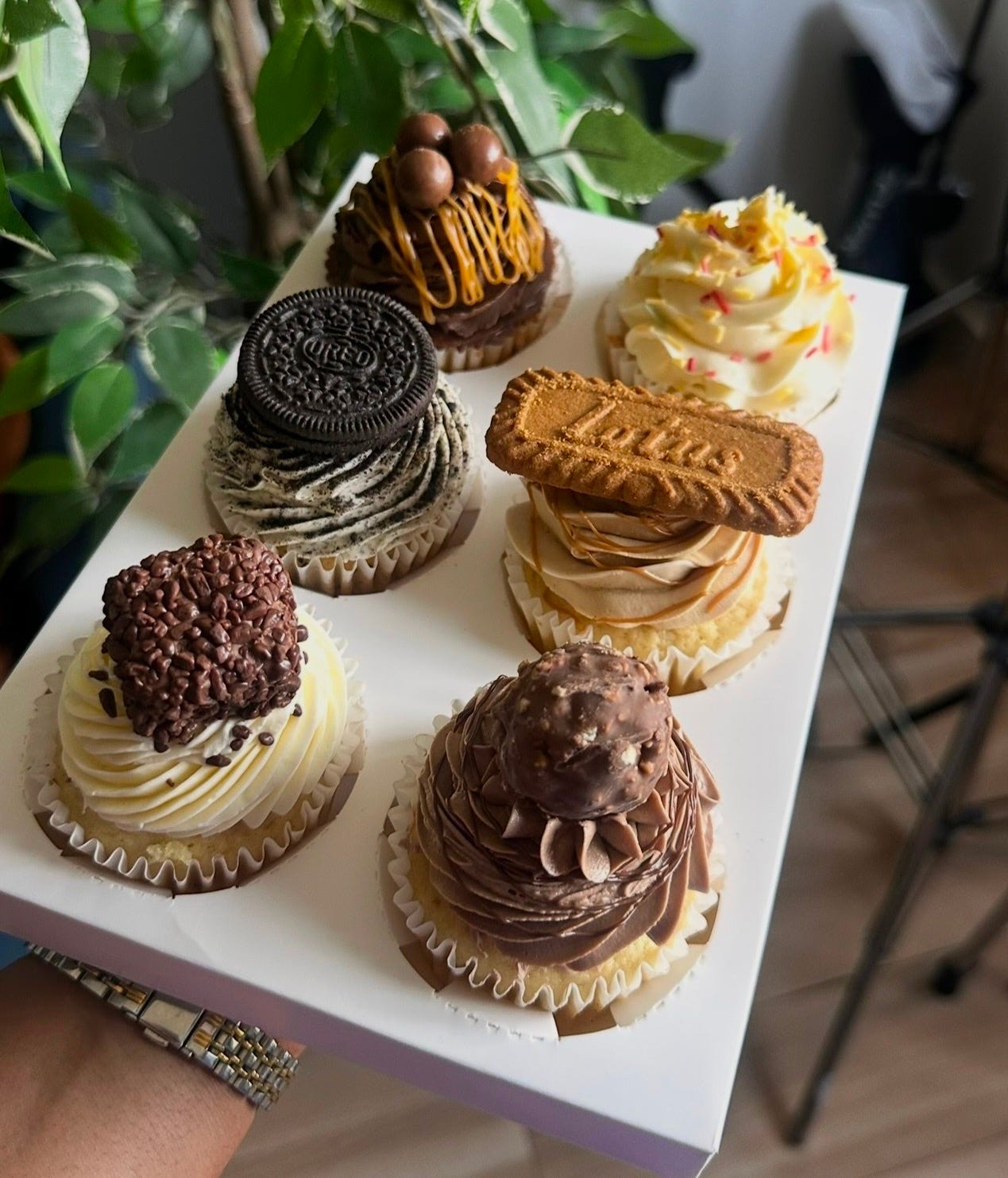
I love baking.
As a failing, recovering sweet-tooth addict, learning how to create the very sweet treats that bring me a lot of joy (and perhaps too much dopamine) was one of my greatest accomplishments. Not because I am good at baking, or had the desire to join the great British Bakeoff. Learning to bake is one of my greatest achievements because it was not about being good at all, it was simply about the joy of it.
As I become more skilled at baking, I developed the habit of bringing something baked, on a whim, for my friends. Brownies, cupcakes, cinnamon rolls…the kind of treats that merit the addition of food into the cannon of love languages.
I would get asked, again and again, when I would start selling. I would bashfully and politely say no each time, stating that I wanted my baking to remain a hobby that brings me joy.
“Ren, you’re missing an opportunity.”
“Wow, you’d make so much money.”
“Isn’t it just a waste of time?”
I have heard all variants of the former and remain all the more resolute that, for a sustainable and gratifying human experience, we must rediscover the art of whimsy.
Somewhere between girlhood and adulthood, someone convinced us that everything we enjoy must also be useful.
The running became a fitness journey which led to a fitness business. The baking became a content series and a digital e-book. The reading became a book club with a productivity angle. The dances became classes for other people to come and join on a weekly basis. Heck, even the morning bible study became a quiet, paid subscription for access to a breakdown of the Word of God.
Somewhere in the conversation, in the monetising, the optimising, the documenting… the joy quietly left the building.
This is not an accident.
It is what hustle culture does to women specifically: it takes the parts of us that were free and puts them to work.
The Passion Economy.
The passion economy is the idea that you should monetise what you love, turn your interests into income, and build a brand around your authentic self. This exploded in the 2010s dressed as liberation, coinciding with the rise of the ‘content creator’ as a legitimate job role.
No more doing work that doesn’t light you up - do what you love and the money will follow.
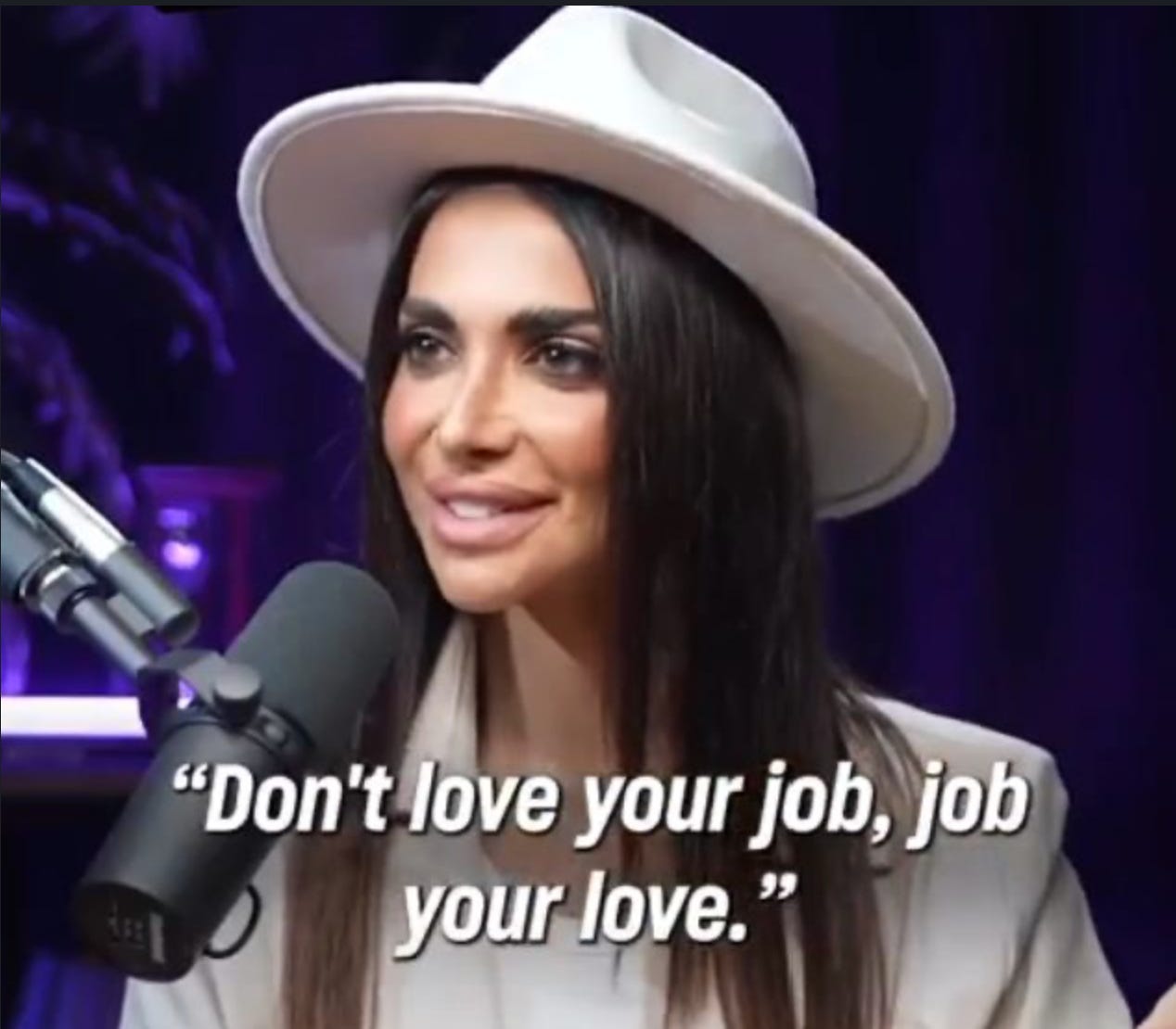
Don’t love your job, job your love.
What it actually delivered was the colonisation of leisure.
When every single hobby becomes a potential revenue stream, the internal calculus of enjoyment shifts. You are no longer asking: does this bring me joy? You are asking: is this good enough to share? Could this be a business? Should I be further along with this by now? Am I enjoying this correctly?
Researcher Cassie Mogilner Holmes, whose work focuses on time and happiness, found that introducing financial incentives into activities people previously did for pleasure reliably reduces their enjoyment of those activities. The psychological term is "overjustification effect", aka when external rewards are introduced for intrinsically motivated behaviour, the intrinsic motivation quietly exits.
You stop doing it because you love it. You start doing it because it pays. Heaven forbid it stops paying.
If it stops paying, or never pays enough, you stop doing it entirely.
What Hustle Culture Stole from Women.
This is not a conversation that is general, but one that is very much gendered.
Historically, women have had less access to sanctioned leisure time than men. In the cultural imagination, particularly in the West, the concept of the man’s shed - the private, purposeless ‘man cave’ where he potters, tinkers and builds things for no reason - has no equivalent for women.
Women's time at home has been earmarked for invisible productivity, such as domestic labour, childcare, emotional labour, the management of everyone else's needs. The idea of a woman doing something purely for herself, with no output, no utility, no benefit to anyone around her, has always carried a faint charge of selfishness.
Hustle culture took this already-compromised relationship with leisure and made it worse.
It gave women permission to have hobbies, but only if those hobbies were also working. Only if they were improving something, producing something, building towards something.
That thing you do just because you love it, with no justification, no audience, no return on investment? That remains deeply culturally suspect for women in a way it simply isn't for men.
When Girlhood Was the First Thing Stolen.
For many women, the relationship with play was severed long before hustle culture got involved. Long before the passion economy arrived with its monetisation frameworks and its accursed personal brand advice.
Some women, like me, never had a girlhood that was free. The childhood that should have been spent in purposeless, joyful, slightly chaotic play was instead spent managing an adult’s emotions, carrying responsibilities that were never theirs to carry, learning to be useful before they had the chance to simply be.
Parentified children, such as daughters who became carers, mediators, emotional anchors for their families before they were old enough to understand what was being asked of them, arrive in adulthood with no map for play at all.
They never learned what it felt like.
For these women, the invitation to be whimsical is not simple. It is not a matter of putting down the phone or resisting the urge to monetise. It is a matter of learning something from scratch that most people take for granted — the experience of being in your body, in the moment, for no reason, with no one depending on the outcome.
Research on adverse childhood experiences and adult play behaviour consistently finds that adults who experienced high levels of childhood stress, parentification, or early responsibility show significantly reduced capacity for spontaneous play. They also, interestingly, show significantly higher rates of chronic productivity as a coping mechanism.
The busyness is not laziness in disguise. It is a nervous system that never learned to rest.
Ouch. I wrote that, and re-read that. Next time, I’ll just @myself directly since this is speaking to me. I have a newsletter called Optimise She, for crying out loud.
If this is you, if the very idea of purposeless joy feels foreign or faintly dangerous, this is not a character flaw. It is a wound. Like all wounds, it can be tended to.
Reclaiming play when girlhood was stolen is slower work than the listicle version suggests. It requires patience, gentleness, and the willingness to feel slightly ridiculous while you find your way back to something that was taken before you knew to hold onto it.
But it is possible. And it is worth it. Because the woman on the other side of that reclamation — the one who has found her way back to something free and purposeless and entirely her own — she is not just healed. She is whole.
The Science of Play.
Here is what we know about what happens in the brain when humans engage in genuine, purposeless play.
Neuroscientist Stuart Brown, founder of the National Institute for Play, spent decades researching the role of play across the lifespan. He found that play is not a luxury. It is a biological necessity. Play builds neural connections, reduces cortisol, and restores the capacity for joy that sustained productivity systematically depletes.
The moment you introduce a specific outcome…a product, an audience, a revenue target… the neurological benefits of play begin to diminish. Your brain is no longer playing. It is working. And work, however meaningful, does not restore what play restores.
Women’s brains need play. Not optimised recovery. Not productive leisure. Not content creation dressed as creativity. Play. Purposeless, slightly ridiculous, nobody-needs-to-know-about-this play.
Also, there is a particular freedom in being bad at something you have no intention of getting better at. If you do get better, great. If not, who cares?
Doing something badly, on purpose, with full commitment, the truly terrible pottery, the off-key singing in the car, the novel that will never be finished and was never meant to be, is a radical act of self-possession. It says: this is mine. It exists for me. It does not need to be good. It does not need to be seen. It does not need to justify itself.
The moment you introduce an audience, the joy changes shape. Keep some things just for you.
The Theology of Delight.
There is a word that appears throughout Scripture that we have largely lost in translation. The Hebrew word shaashua, sometimes rendered as “delight,” sometimes as “play,” sometimes as “joy.” It appears in Proverbs 8, where Wisdom herself speaks of being at God’s side at creation, describing herself as playing, delighting, rejoicing before him daily.
Before the world was ordered, before the work began…there was play.
The tradition that gave us the Sabbath understood something about the human relationship to rest and play that the passion economy has entirely forgotten. A full day of rest built into the structure of creation itself. Sacred.
You were not created only to produce, but also to delight. The capacity for whimsy, for purposeless joy, is not a distraction from your calling. It is woven into what it means to be made in the image of a God who, before anything else, played.
Zephaniah 3:17 describes God rejoicing over His people with singing. Not with strategy, or with a plan. Just singing. Just delight. Just something that looks, from the outside, entirely playful.
The parts of you that need to play are not the parts you need to discipline into usefulness. They are the parts that are most like Him.
—
SIT WITH THIS
When did you last do something purely because it made you feel alive, with no audience, no output, no justification? Just something that was entirely, unapologetically yours.
If you can't remember, that is the answer.
✦ OPTIMISE SHE THIS WEEK
Three things to protect and reclaim your joy.
Reclaim one hobby this week with no output attached. Do it without documenting it, sharing it, or measuring progress. If the urge to photograph it arises, notice it. Oh, and put the phone down. The experience only counts if it stays yours.
Identify what you used to do just for fun. Before anyone told you it could be a business, before the algorithm got involved. Write it down. Then do it once this week, badly, with full commitment.
Give yourself one hour of pointless time. Not self-care. Not recovery. Not productive rest. Genuinely, gloriously pointless, and spent on something that makes you feel like yourself for no reason anyone else needs to understand.
✦ PASS IT ON
Optimise She is built to support women on a journey to wholeness. Make sure you’re subscribed - and share with a woman who needs it this week. 🌱
This was a great read. Thanks!
Love love this, I was reflecting yesterday on whether Christians really have fun. Reading this felt like God's response to that question, to intentionally add play and whimsy to my rhythms for the pursuit of His joy. Thank you Renée